5 reasons cleaning experts are giving up plastic spray bottles (and what they use instead)
Most of what's in the bottle is water, and some of the rest ends up in the air you breathe. Here's what people who clean for a living do differently, and what to buy instead.
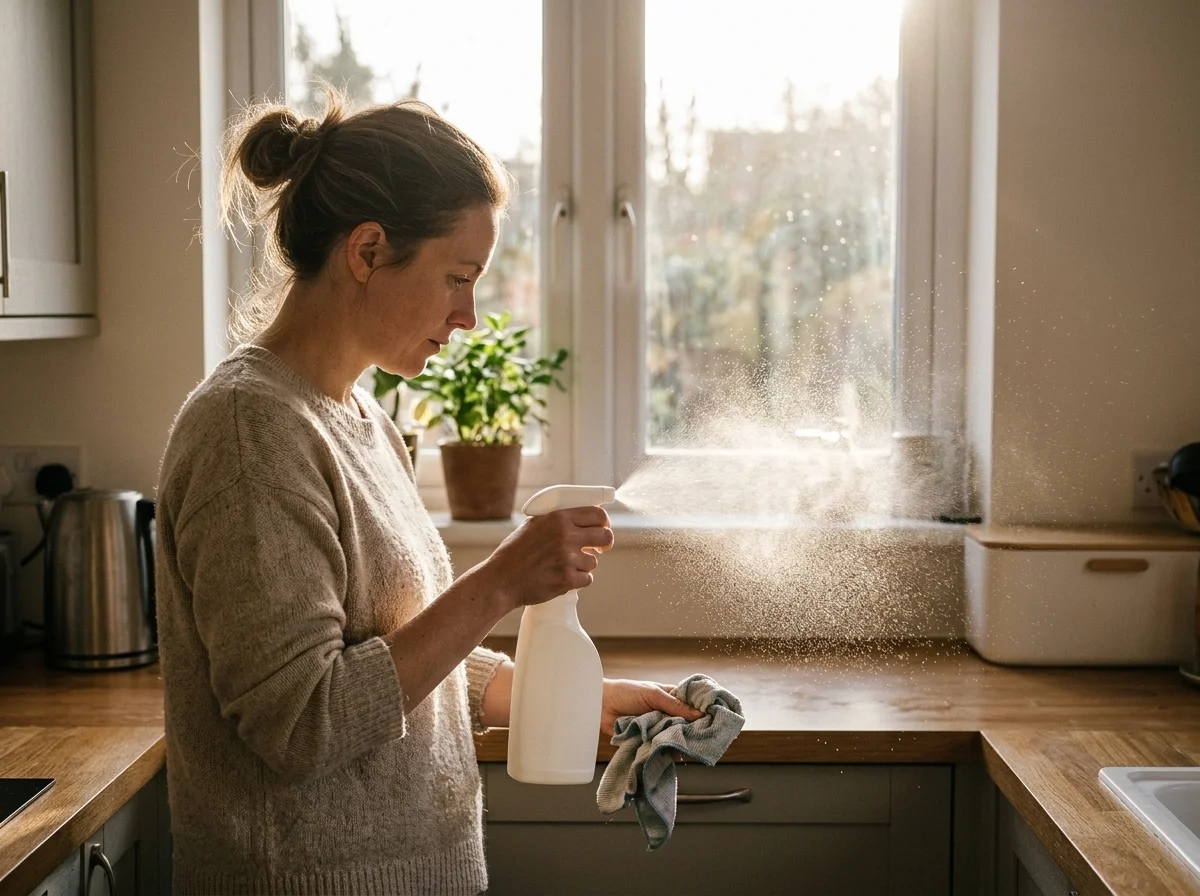
Last Sunday the low sun was shining through my kitchen window while I cleaned the worktop. I sprayed, and then I actually saw it: a fine cloud of cleaner hanging in the light, right at the height of my face.
I write about healthy cleaning for a living. I knew the studies on professional cleaners, who breathe these sprays all day, and I knew why so many of them now clean differently. I'd just never thought about the bottle in my own hand.
So I turned it around. The main ingredient was water and then came a list of chemicals. I was shocked because that was already my third bottle that autumn.
If you reach for a plastic spray bottle every day, here are the five things I'd want you to know before you buy the next one. The last one surprised me most, because it was in my other hand the whole time.
Spraying puts chemicals in the air you breathe
When you pull the trigger, not all of the cleaner lands on the worktop. Part of it turns into a fine mist that floats at face height while you clean, so you breathe it in with every wipe.
adults were followed for around nine years in a large European study. Those who used cleaning sprays at least once a week were more likely to develop asthma, and the more often they sprayed, the higher the risk.Zock et al., Am J Respir Crit Care Med, 2007
The people most exposed are the ones who clean for a living. They breathe this mist for hours a day, so they were the first to be studied and the first to change how they work. Their easiest change is one you can make tonight: spray onto the cloth, not into the room.
But the mist is only half of it. What matters just as much is what's in it.
Some ingredients don't belong in an everyday spray
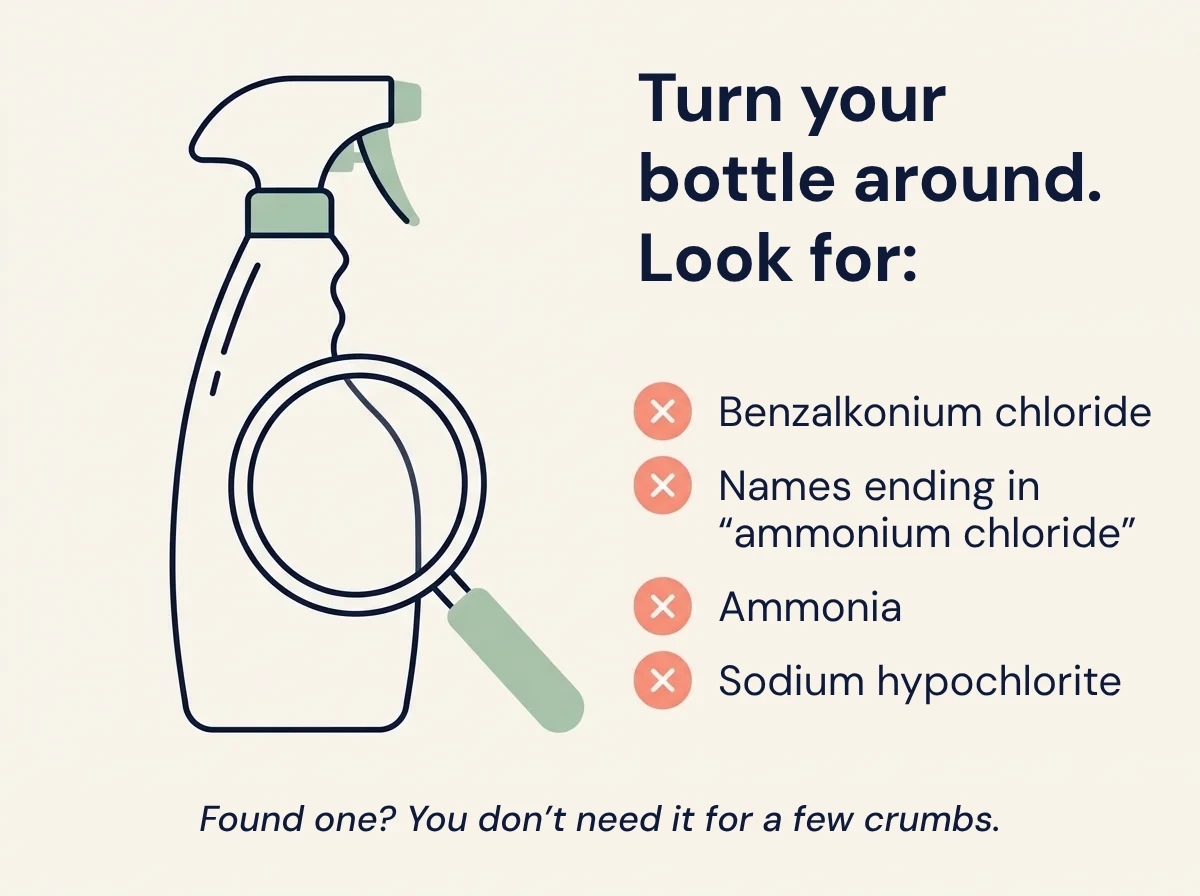
Most supermarket sprays are made to disinfect, even when all you want is to wipe crumbs off the table. To kill germs they use quaternary ammonium compounds (quats for short, such as benzalkonium chloride), ammonia or chlorine bleach, and those are what's floating in that mist.
Benzalkonium chloride is a recognised cause of asthma in professional cleaners, and in 2023 a team of scientists called quats "a chemical class of emerging concern".
For everyday dirt and grease you don't need any of them, because plant-derived cleaning agents lift the dirt into the cloth perfectly well.
Turn your bottle around and look for: benzalkonium chloride, any other name ending in "ammonium chloride", ammonia or sodium hypochlorite.
"Smells clean" isn't the same as clean
That fresh lemon or ocean smell is one of the oldest tricks in cleaning. It tells you the job is done and it covers the chemical smell underneath, but perfume doesn't remove a single crumb.
What it does is add to the air. When researchers at the University of York measured what household cleaners release indoors, fragrance compounds were the most common chemicals they found. If your kitchen still smells of "fresh linen" an hour after cleaning, that's an hour of perfume your family is breathing. A clean kitchen doesn't need a strong smell, so choose a light scent, or none at all.
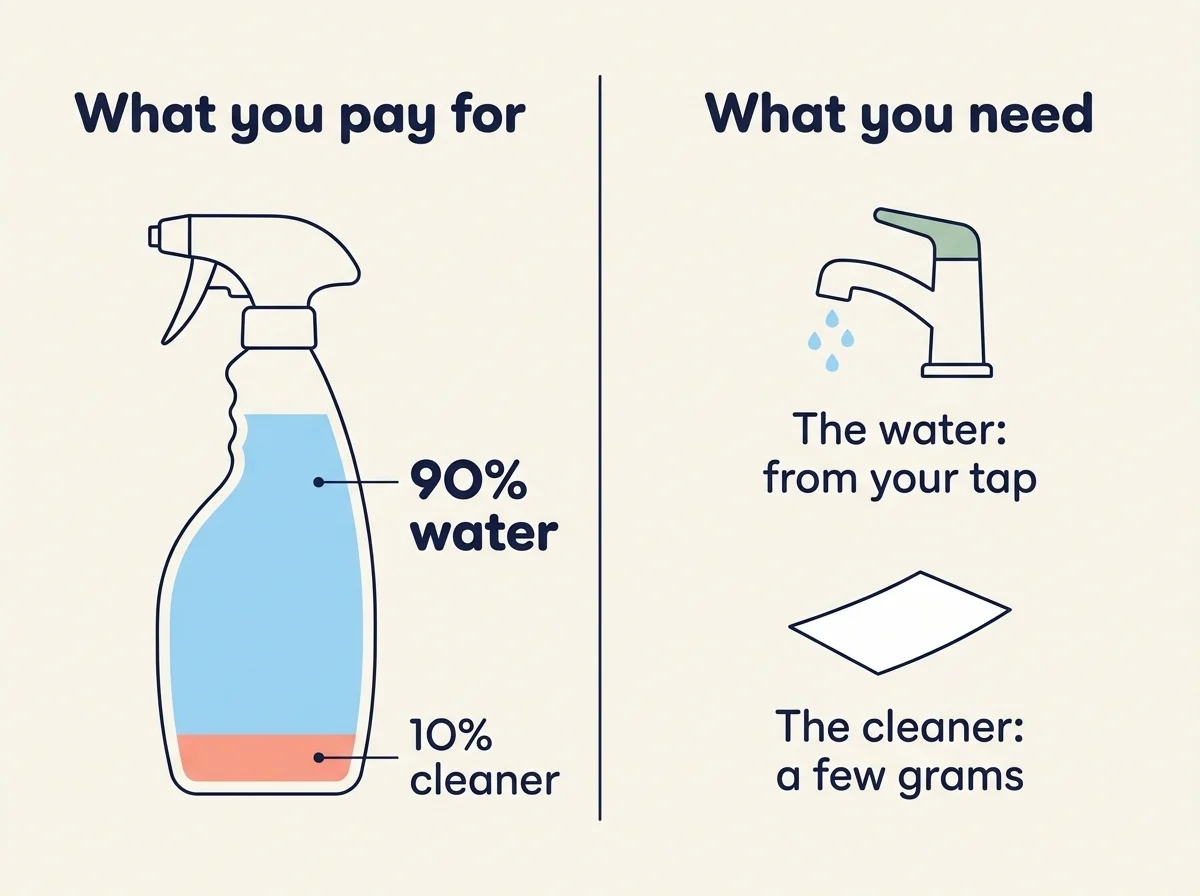
You're paying for 90% water
According to the Ellen MacArthur Foundation, a typical bottle of cleaner is about 90% water. That water is bottled in a factory, driven across the country and carried home by you, and you pay for every step of it, while the same water comes out of your tap for a fraction of the cost.
of the EU's plastic packaging waste was recycled in 2023. The rest was burned, buried in landfill or shipped abroad.Eurostat, packaging waste statistics
The empty bottle rarely gets a second life either, because it mixes several plastics with a metal spring and has to be taken apart before it can be recycled.
The fix is simple: keep one good bottle and add the water yourself. A dissolvable sheet weighs a few grams, so you stop paying to ship water and stop binning a bottle every few weeks.
Your microfibre cloth is plastic
This is the one I didn't see coming. Microfibre is made from polyester and nylon, so the cloth I was holding that Sunday was a plastic cloth, and many eco refill kits even put one in the box.
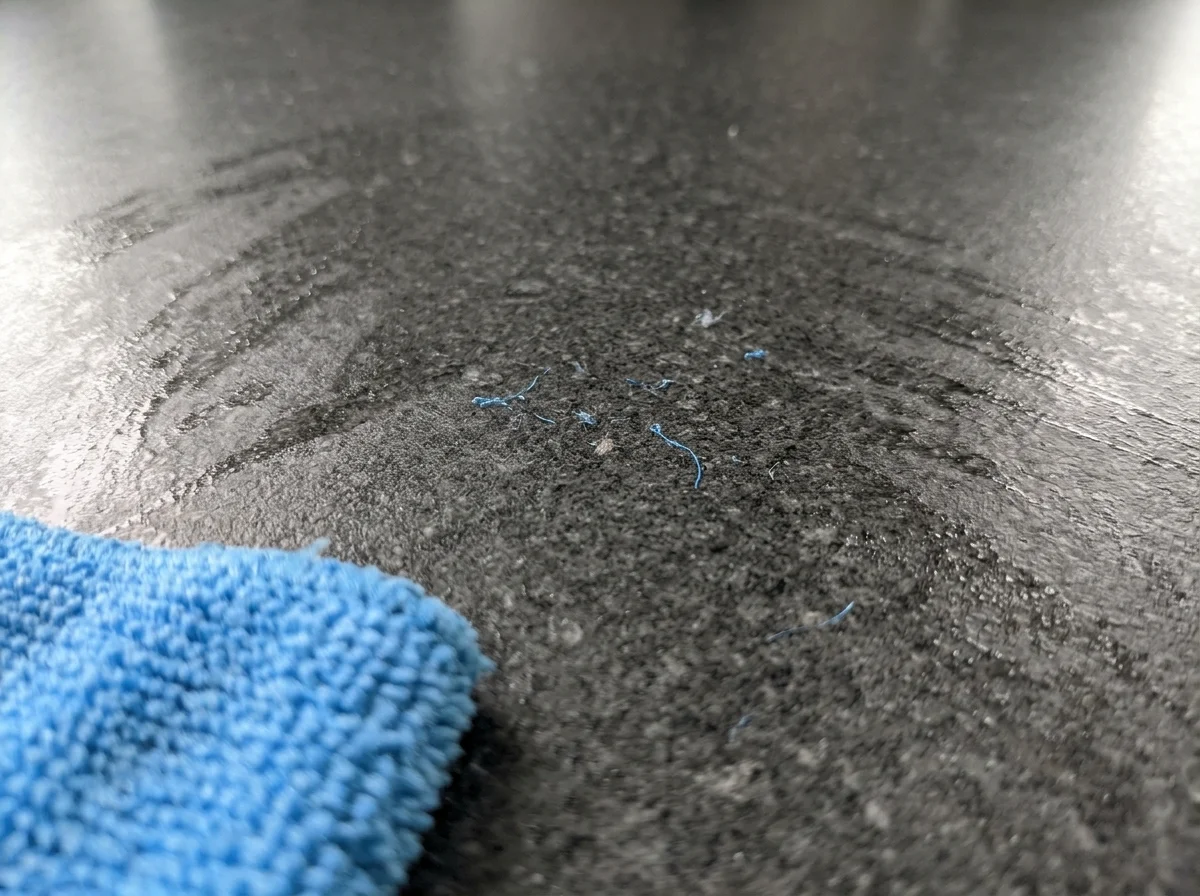
Tiny plastic fibres break off every time you wipe and every time you wash it. The European Environment Agency estimates that around 8% of the microplastics Europe releases into the ocean come from synthetic textiles, and indoors those fibres end up in the dust and the air of your home.
healthy adults had plastic particles in their blood in a 2022 study at Vrije Universiteit Amsterdam. That same year, researchers found microplastic fibres in living human lung tissue for the first time.Leslie et al. 2022 · Jenner et al. 2022
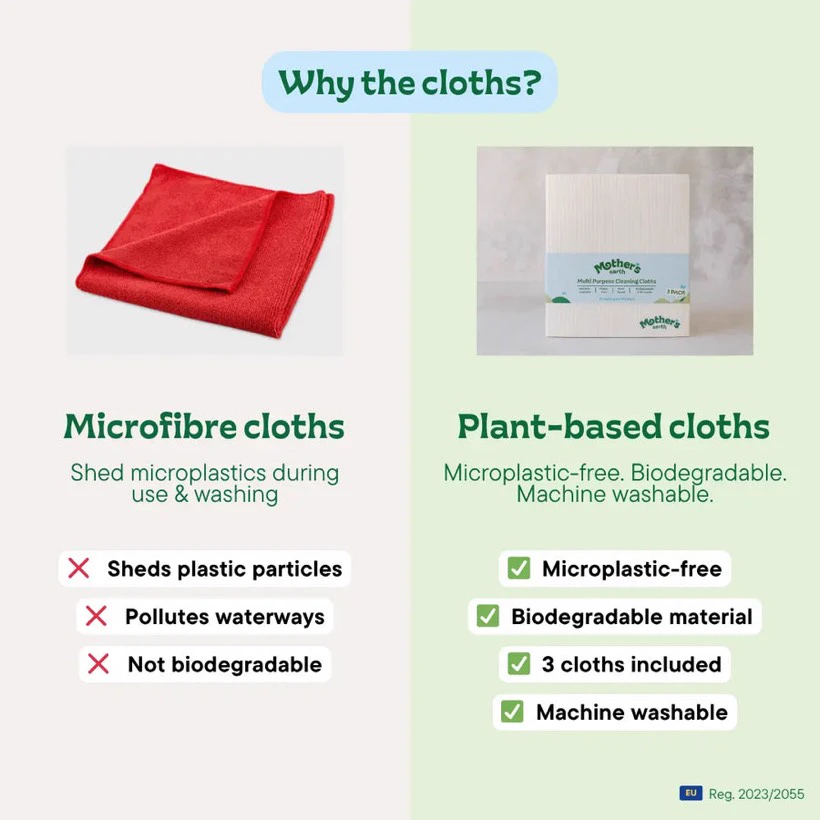
The fix is to switch to cloths made from plant fibres, like cellulose and cotton. They soak up just as much and you can wash them at 60 °C.
What to use instead: the 5-point checklist
If you're replacing your spray, tick these five boxes. Most sprays and refill kits tick one or two.
- ✓No quats, ammonia or chlorine bleach
- ✓A light scent, or none at all
- ✓Refills without the water, mixed with tap water at home
- ✓A bottle you keep, not single-use plastic
- ✓Cloths that aren't plastic, like cellulose and cotton
| Supermarket spray | Typical eco refill kit | Mother's Earth kit | |
|---|---|---|---|
| No quats, ammonia or bleach | Often not | Varies | ✓ |
| Light scent or fragrance-free | Rarely | Varies | ✓ |
| Refills without water | ✗ | ✓ | ✓ sheets |
| A bottle you keep | ✗ | ✓ | ✓ glass |
| Cloths that aren't plastic | ✗ | Usually microfibre | ✓ cellulose and cotton |
The kit that ticks every box
Of everything I looked at, only one kit ticks all five: the Multi-Purpose Cleaner starter kit from Mother's Earth, a Dutch family brand whose products are used by more than 500,000 people.
You roll one sheet into the frosted glass bottle, add 300 ml of tap water and shake. Four sheets make four full bottles, and the kit comes with three cloths made of cellulose and cotton instead of microfibre.

I've used it in my own kitchen for a month now. I spray onto the cloth, and one wipe takes the grease off the hob front. The Herbal Fresh scent is soft and green, nothing like the perfume cloud I used to clean in, and the bottle lives on the counter instead of under the sink.
It has 4.7 out of 5 stars from 163 reviews, and this one sums up what most of them say:
"I love the smell and particularly the idea that the product is natural and thus, will not leave toxic chemicals behind. The cloths are also biodegradable, which is much better than the microfiber ones that leave so many microplastics."Verified review
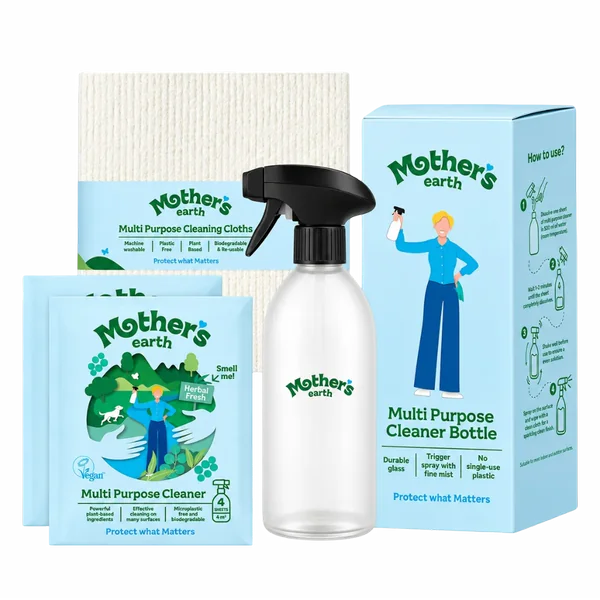
Mother's Earth Multi-Purpose Cleaner
- 4 sheets = 4 × 300 ml bottles
- A frosted glass bottle you keep
- 3 cloths without microplastics
- Free from quats, ammonia, chlorine bleach, phthalates and dyes
- Herbal Fresh or Fragrance Free
Starter kit from £17.99 · Black Friday sale · 30-day money-back guarantee
Check the Black Friday price →Before you switch
Will it really cut grease?
For everyday kitchen dirt and grease, yes. Plant-derived cleaning agents and saponins lift grease the same way conventional ones do. What they don't do is disinfect, so keep a dedicated product for the rare times you really need that.
Is it more expensive than my supermarket spray?
Per bottle, a little. But the kit includes the glass bottle and three cloths you'd otherwise buy separately, and you're no longer paying to have water bottled and shipped. With the 30-day money-back guarantee, you can try it for a month and get your money back if you're not happy.
Does Herbal Fresh smell strong?
No. It's a soft herbal scent that doesn't hang around the room the way supermarket sprays do. If you'd rather have no scent at all, there's a Fragrance Free version.
Which surfaces can I use it on?
Worktops, tables, hob fronts, cupboard doors, sealed wood, tiles, stone and marble. Don't use it on screens or electronics.
- Ellen MacArthur Foundation, Replenish circular example (cleaners about 90% water).
- Eurostat, packaging waste statistics, 2023 data (42.1% of EU plastic packaging waste recycled).
- Zock J-P. et al. (2007). Am J Respir Crit Care Med. Cleaning sprays and adult asthma, ECRHS.
- Arnold W.A. et al. (2023). Environ Sci Technol 57:7645. Quaternary ammonium compounds review.
- Harding-Smith E. et al. (2024). Environ Sci: Processes & Impacts. VOCs from household cleaners.
- European Environment Agency. Microplastics from textiles (briefing).
- Leslie H.A. et al. (2022). Environment International 163:107199. Plastic particles in human blood.
- Jenner L.C. et al. (2022). Sci Total Environ 831:154907. Microplastics in human lung tissue.
Prices at the time of writing.
Note: This article is supported by Mother's Earth. All experiences and opinions shared here are my own. This article contains affiliate links.