We tested the most popular detergents for harmful chemicals
In every detergent we looked at, the same group of substances kept turning up: ethoxylates. You've probably never heard of them, yet they're in your washing liquid, in your capsules and even in the "eco" brands. And making them creates a substance that officially classifies as "may cause cancer".
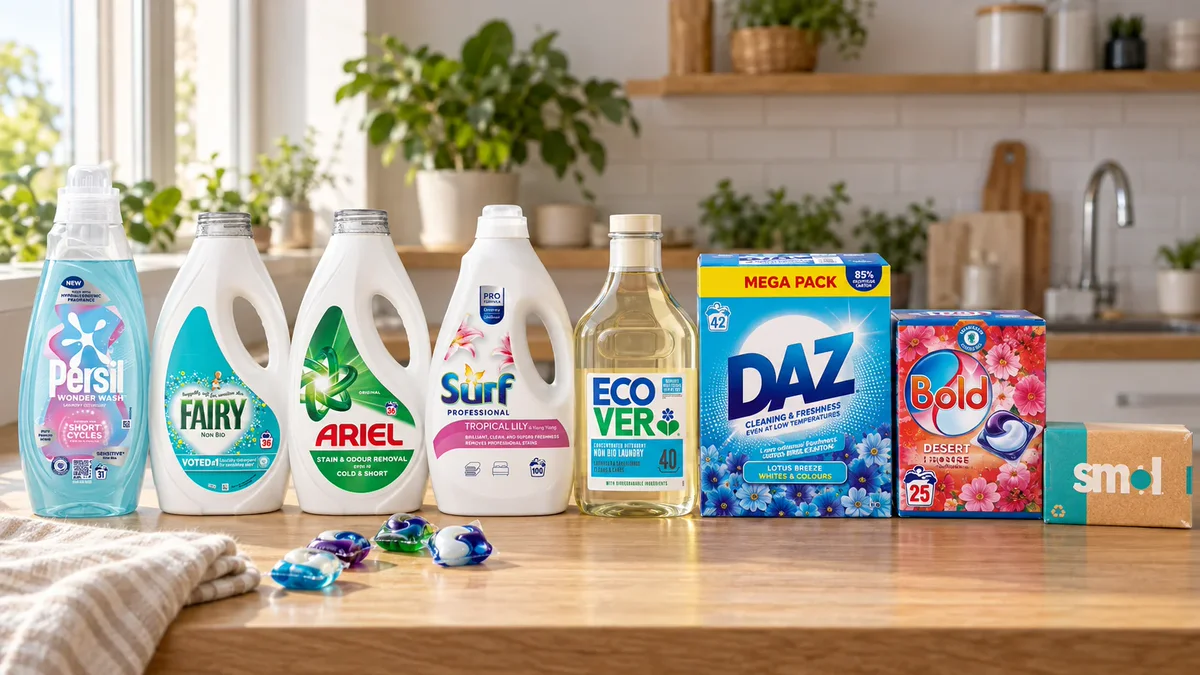
You do your laundry without thinking about it. A capful of washing liquid or a capsule in the drum, programme on, done. Your clothes, your bed linen, your little one's babygrows: everything goes through it, and afterwards your family wears it on their skin all day.
But what's actually in it? We read the full ingredient lists that the manufacturers publish online themselves. The front of the bottle says "brilliantly clean" and "gentle on skin". On those lists, we found the same kind of substance in every single product.
What are ethoxylates?
Ethoxylates are synthetic surfactants, the ingredients that do the washing. They loosen dirt and grease, they foam well and they're cheap, which is why they're among the most widely used surfactants in washing liquid and capsules.
How to spot them: look for names containing these words or word parts.
What we found in the UK's best-known detergents
All 35 washing liquids, capsules and powders we checked from Persil, Fairy, Ariel, Surf, Bold, Daz, Ecover and smol contain at least one ethoxylated ingredient. Ariel's washing liquid contains eleven. Fairy Non-Bio, the one so many parents trust for baby clothes, contains ten.
| Product | Count | Ethoxylates on the list (verbatim) |
|---|---|---|
| Ariel Original washing liquid | 11 | C15 Pareth-n, Sodium Laureth Sulfate, Co-polymer of PEG / Vinyl Acetate, PEI Ethoxylate, C12-14 Pareth-n, Sulfated Ethoxylated Hexamethylenediamine Quaternized, PEG/PPG-10/2 Propylheptyl Ether, C12-16 Pareth-n, Polyethylene glycol, Steareth-2, PEG-30 Stearate |
| Fairy Non-Bio washing liquid | 10 | C15 Pareth-n, Sodium Laureth Sulfate, Sulfated Ethoxylated Hexamethylenediamine Quaternized, Co-polymer of PEG / Vinyl Acetate, C12-14 Pareth-n, PEG/PPG-10/2 Propylheptyl Ether, C12-16 Pareth-n, Polyethylene glycol, Steareth-2, PEG-30 Stearate |
| Bold All in 1 Pods | 9 | MEA-Laureth Sulfate, C12-14 Pareth-n, Sulfated Ethoxylated Hexamethylenediamine Quaternized, PEI Ethoxylate, C12-16 Pareth-n, Polyethylene Glycol, Ethoxylated m-toluidine, PEG Copolymer, PEG-N Methyl Ether |
| Persil 4 in 1 Non Bio Capsules | 6 | Laureth-7, MIPA-Laureth Sulfate, PEG-8, Tripropylene tetramine ethoxylated modified, Polypropylene Terephthalate/Polyoxyethylene terephthalate, Laureth-3 |
| Persil Wonder Wash Sensitive | 4 | Sodium Laureth Sulfate, Laureth-7, Tripropylene tetramine ethoxylated modified, Steareth-20 |
| Surf Tropical Lily washing liquid | 4 | Laureth-7, Sodium Laureth Sulfate, Tripropylene tetramine ethoxylated modified, Steareth-20 |
| Ecover Non-Bio laundry liquid | 2 | Laureth-7, Bio poly ethyleneglycol propyleneglycol oligo ester |
A selection from 35 checked products. Source: the manufacturers' own ingredient databases (P&G info-pg.com, Unilever wiop.unilever.co.uk, Ecover uk.ecover.com, smol smol.com). For supermarket own brands such as Tesco's, we couldn't find a full ingredient list online. Checked October 2026.
Even the versions made for sensitive skin are no exception, and neither are the eco brands. Ecover and smol, two of the best-known "eco" names, both use them, so green packaging tells you nothing about this group of substances.
What is 1,4-dioxane, and why is it such a problem?
1,4-dioxane forms as a by-product of ethoxylation. Manufacturers can remove a large part of it, but whether they do, and how thoroughly, is something you can't check anywhere as a shopper, because it isn't on the list.
In New York it had to come down. And it did.
In the US state of New York, a legal limit has applied since the end of 2023: at most 1 ppm of 1,4-dioxane in cleaning products and detergents. An environmental organisation had the same well-known detergents tested there, before and after the law.
Citizens Campaign for the Environment, 2019 and 2024. American formulas; European and UK measurements aren't public.
So manufacturers can bring it down when they have to. Here they don't have to, and nobody publishes what's in the bottles that are sold.
It doesn't disappear after rinsing either
1,4-dioxane barely breaks down and isn't removed by ordinary water treatment. That's why the American environmental agency, the EPA, explicitly names detergent use as one of the sources that add to water pollution via the sewer.
Europe knows the problem too. The Rhine provides the drinking water for around 30 million people, and in autumn 2018 samples from the lower Rhine came in above the German Environment Agency's health guideline value. According to the German environment agencies, those high readings came from industrial wastewater rather than from washing machines at home. But every bottle of detergent with ethoxylates starts at exactly that production.
Laundry sheets: the clean alternative?
More and more people are switching to laundry sheets: thin, dry sheets that dissolve in the drum. They're sold as the natural, healthier alternative to washing liquid. But is that also true for this group of substances?
When we put the ingredient lists of the seven most popular laundry sheets in the UK side by side, we still found ethoxylates in 6 of the seven. So it's a different format, but often the same surfactants.
One brand went a step further.
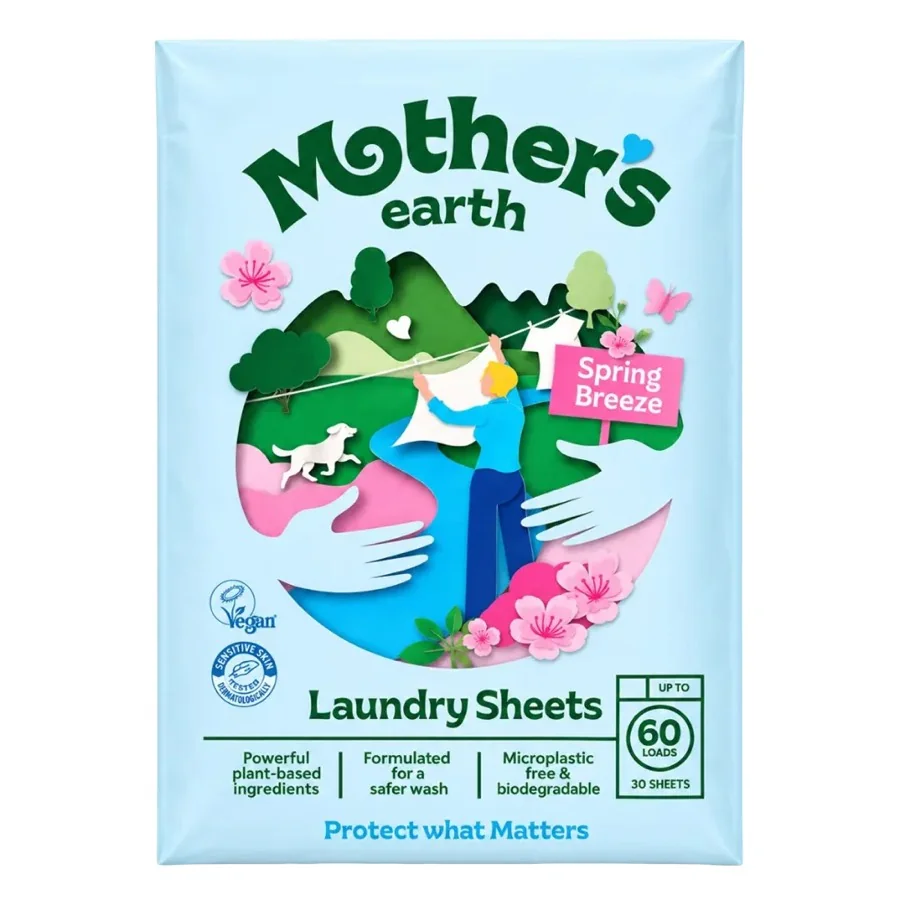
Mother's Earth
The Dutch family business of mother and son Lisette and Floris deliberately leaves ethoxylates out of its standard laundry sheet. Stains are broken down by enzymes instead of synthetic surfactants, and the brand had an independent lab test what's not on the box.
- No ethoxylates in the standard laundry sheet, and every ingredient is online with its CAS number
- SGS Institut Fresenius: no 1,4-dioxane, heavy metals or parabens detected
- Enzymes (protease) that break down stains, even at 15 °C
- Dermatest "Excellent", and the fragrance-free sheet carries the seal for sensitive skin
- 30 days to try a full pack, or your money back
| SGS lab test Mother's Earth | Result | Detection limit |
|---|---|---|
| 1,4-dioxane | Not detected | 5 mg/kg |
| Heavy metals(arsenic, antimony, lead, cadmium, mercury) | Not detected | 0.05–0.5 mg/kg |
| Phthalates harmful to reproduction(DEHP, DBP, BBP and DiBP) | Not detected | 1 mg/kg |
| Optical brighteners | Not detected | 0.005% |
| Parabens | Not detected | 0.0005% |
SGS Institut Fresenius, test report no. 7751379, December 2025. Sample: Mother's Earth Laundry Sheets Spring Breeze. "Not detected" means below the lab's detection limit.
How to check your own detergent
- Look up the full ingredient list on the manufacturer's website. The bottle often only shows groups like "non-ionic surfactants".
- Search for "eth", "pareth", "PEG" or "ethoxylated". If you find them, your detergent contains ethoxylates. On capsules you'll often spot one in the small print on the pack itself, after the word "Contains".
- Ask for a lab test on 1,4-dioxane. A brand that says its product is free of it should be able to show it.
Frequently asked questions
Should I throw my detergent away now?
No. Ethoxylates are simply allowed, and the American environmental agency EPA found no unacceptable risk for people who use detergent at home. The point is that you can't see how much 1,4-dioxane is in your bottle. If you'd rather avoid that uncertainty, choose a detergent without ethoxylates next time you buy.
Why isn't 1,4-dioxane on the packaging?
Because it isn't an ingredient but a residue from making other ingredients, and a label only lists what's added on purpose.
So are eco detergents free of ethoxylates?
Not necessarily. Ecover and smol, two of the best-known eco brands, both use them: Ecover's non-bio liquid lists Laureth-7, and smol's lists C12-18 Pareth-7. So always look at the ingredient list rather than the packaging.
Isn't non-bio better for sensitive skin?
It's what most of us were told, but Which? says there's "little scientific evidence" that enzymes cause skin irritation, and in its latest tests not a single non-bio detergent was good enough to be a Best Buy. "Non-bio" only tells you there are no enzymes in the bottle. It tells you nothing about ethoxylates, and Fairy Non-Bio's liquid lists ten.
Does a detergent without ethoxylates actually clean?
Yes, if it contains enzymes. Enzymes like protease break down stains from sweat, grass and food, even at low temperatures.
Where can I find the ingredient list for my detergent?
Manufacturers have to publish the full list online. For Ariel, Fairy, Bold and Daz it's on info-pg.com, for Persil and Surf on wiop.unilever.co.uk, and for Ecover on uk.ecover.com.
- Ingredient lists: P&G (info-pg.com, United Kingdom), Unilever (wiop.unilever.co.uk), Ecover (uk.ecover.com), smol (smol.com/uk). Checked October 2026.
- ECHA, RAC opinion 15 March 2019 (1,4-dioxane, Carc. 1B); Delegated Regulation (EU) 2021/849.
- ECHA, candidate list of substances of very high concern (SVHC), 1,4-dioxane added July 2021.
- ECHA, Registry of restriction intentions: 1,4-dioxane in surfactants, withdrawn August 2025; BAuA REACH-CLP-Biozid Helpdesk, "Rücknahme des RoI-Eintrags für 1,4-Dioxan" (28 August 2025).
- New York State DEC: limits for 1,4-dioxane in household cleaning products (2 ppm from 31-12-2022, 1 ppm from 31-12-2023).
- Citizens Campaign for the Environment (2024). Laundry detergent samples show lower amount of 1,4-dioxane.
- US EPA (November 2024). 1,4-Dioxane risk evaluation, non-technical summary.
- IKSR, Bewertung und Entwicklung der Rheinwasserqualität 2019/2020; LANUV NRW, Warn- und Alarmplan Rhein, 1,4-Dioxan (October 2018).
- Which? (September 2026). Bio vs non-bio washing powder.
- SGS Institut Fresenius GmbH, test report no. 7751379 (December 2025).
- HERA, Human & Environmental Risk Assessment: alcohol ethoxylates.