"Kills 99.9% of Germs" Is the Problem: The 5 Multi-Purpose Sprays I'd Actually Use Around a Baby or Toddler
Your little one eats off the high chair tray and puts everything in their mouth, so what you spray there matters more than most parents realise. I checked 9 popular sprays against 5 simple tests, and only one passed all five. You won't find it on a supermarket shelf.
By Lena, home and health editor and mum of a toddler · Updated November 2026 · 4 min read
Why I turned the bottle around
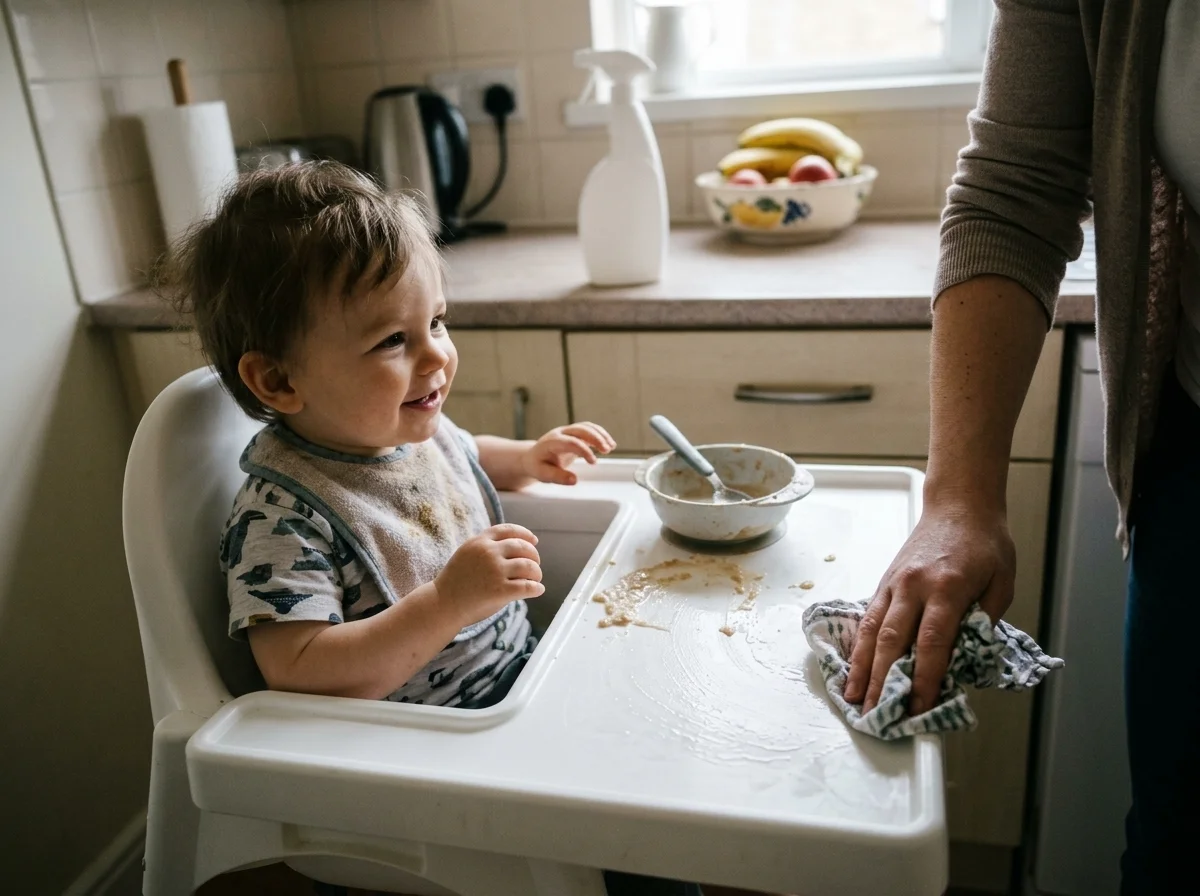
If you have a baby or a toddler, you probably clean the same few surfaces over and over again. For me it's the high chair after breakfast, the kitchen table after lunch, and the floor where my daughter spends most of the afternoon crawling around, picking things up and putting her fingers in her mouth.
Like most parents, I never really thought about what I was spraying on them. I grabbed the bottle under the sink, gave the tray a few squirts and wiped it, sometimes five or six times a day.
That changed when I came across a study that followed 2,022 babies from birth and asked their parents how often they cleaned with everyday products.
In the homes that used cleaning products the most, 65% more children had asthma by their third birthday than in the homes that used them least.
The researchers explained why babies are hit hardest: they spend almost all their time indoors, they breathe faster than adults do, and they touch every surface around them.
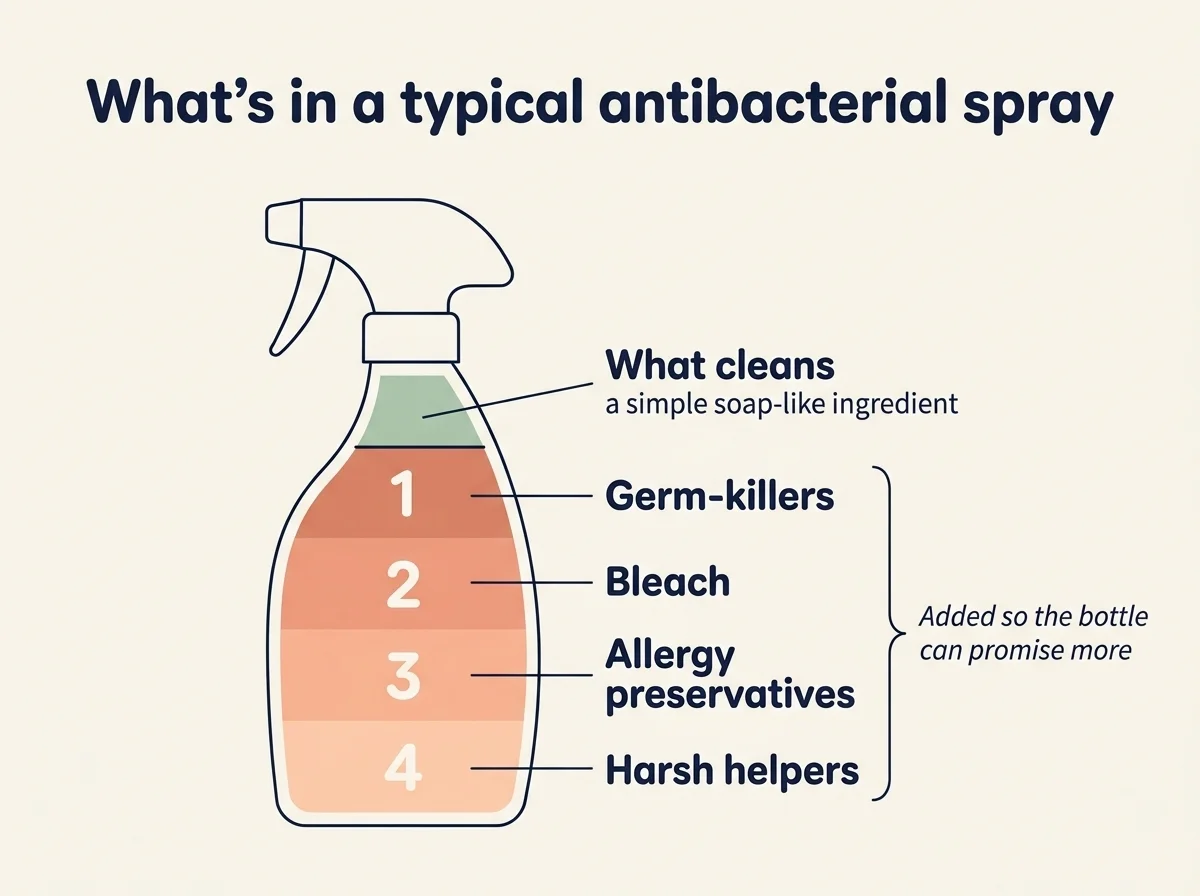
So I read the label properly for the first time, then did the same with eight more of the most popular sprays. What surprised me was this: the part of a spray that actually cleans is simple. It's a soap-like ingredient that grabs grease on one side and water on the other, so the dirt lifts off and goes into your cloth. The worrying ingredients are the ones added on top of it, so the bottle can promise you something a soap can't.
And the spray I'd been using on my daughter's tray since the day she started solids? It came joint last. I'll tell you which one it was further down, but first, here's what I found inside these bottles.
The 4 ingredients I don't want anywhere near my baby
Once you know these four, you'll spot them on almost every bottle in the cleaning aisle.
1. The germ-killer behind "kills 99.9%"
The most common germ-killer in everyday sprays is a family of chemicals called quats. On the label you'll usually see it as benzalkonium chloride, or another name ending in "ammonium chloride", and it's what allows a bottle to promise it kills 99.9% of bacteria. In 2023, a team of scientists called quats "a chemical class of emerging concern", health and safety researchers have linked them to asthma in professional cleaners, and they're highly irritating to the skin.
Now think about where we spray them: on the tray our toddler eats from, the table they lean their face on and the floor they crawl across before putting their hands in their mouth, all to kill germs that a soap-like cleaner and a cloth already wipe away.
Your kitchen table isn't an operating theatre. It needs cleaning, not sterilising, and that turns out to be the key to the whole ranking, as you'll see at number one.
Found in: Dettol, Zoflora and Cif
2. Bleach
Plenty of kitchen sprays still come "with bleach". In a study of more than 9,000 schoolchildren, children whose parents cleaned with bleach at home had more flu, tonsillitis and other infections, and the researchers think the fumes irritate young airways enough to let infections take hold.
Found in: the "with bleach" sprays from Flash, Cif and most supermarket brands
3. The preservative dermatologists called an "epidemic"
Many brands keep their sprays fresh with a cheap group of preservatives called isothiazolinones, which you'll see on the label as MI, MCI or BIT. In 2013, the British Association of Dermatologists warned of an "epidemic" of skin allergy caused by them, and once someone has become allergic, it stays that way for life. That's not something I want on the surfaces my daughter's hands and cheeks touch all day, least of all if your little one has eczema.
Found in: Flash Spray Wipe Done, and other sprays in the Flash and Dettol ranges
4. The harsh helpers
Then there are the ingredients that make a spray cut grease a bit faster or look nicer in the bottle: caustic soda and phosphates, solvents, EDTA, and dyes. None of them does anything for your family that a gentler ingredient can't do instead.
Found in: Dettol, Cif, Zoflora and Smol (dye)
Put together
Each of these is usually used in a small amount, but they rarely come on their own. A typical antibacterial spray combines two to four of them, and we use it several times a day, at the height of our baby's face, in the home where they spend almost all their time. That's exactly the pattern the asthma study measured.
The good news is that you don't need any of them to get a surface clean. The soap-like part stays, and everything else is extra.
How I scored the sprays
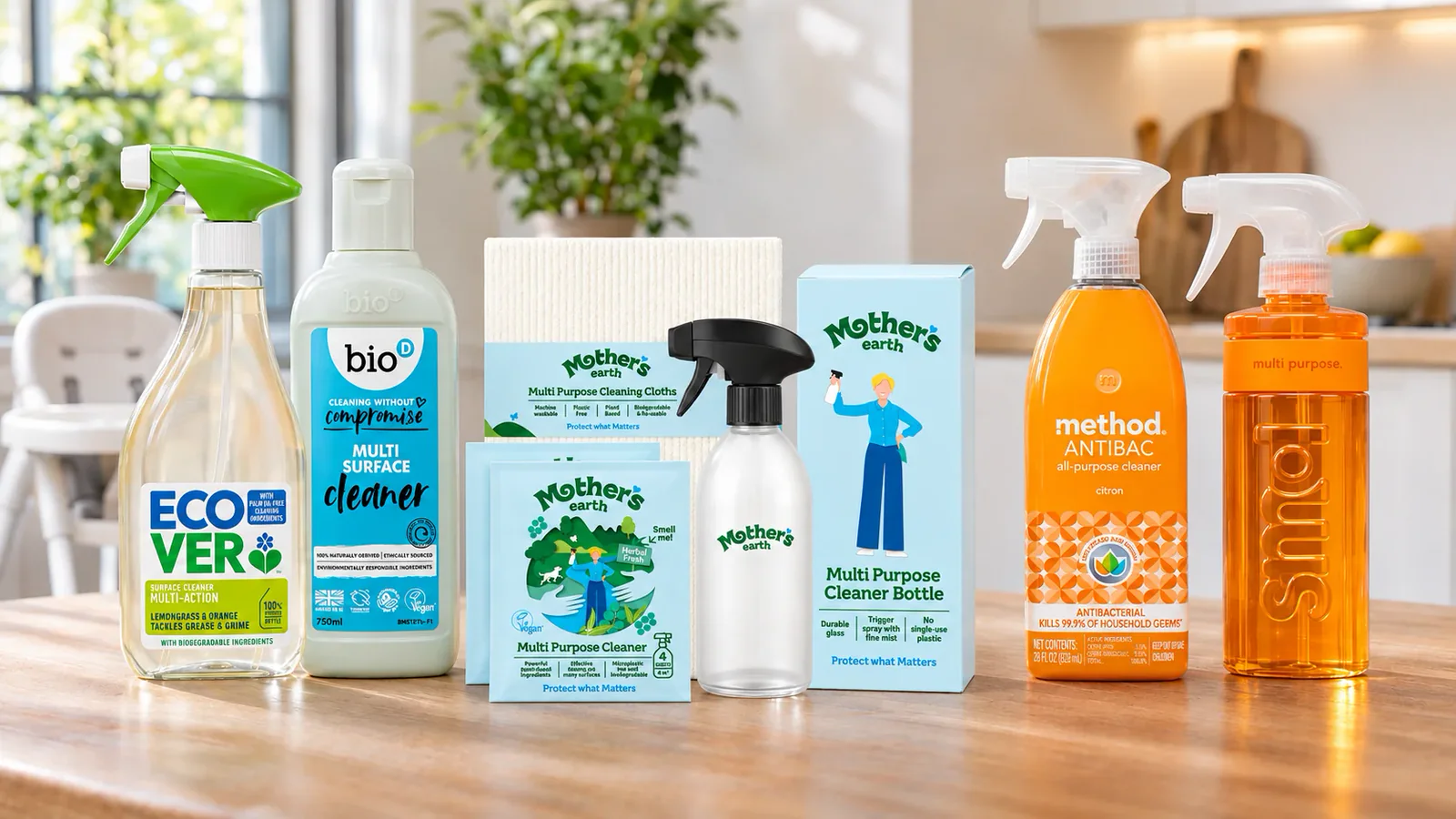
I picked nine sprays that are easy to buy, from the four best-selling household names to three eco brands, a letterbox refill brand and Mother's Earth. Then I asked every label the same question, would I spray this on my daughter's high chair tray?, which came down to five tests, one point each:
- No germ-killers
- No bleach or ammonia
- No allergy-causing preservatives
- No harsh helpers or dyes
- No plastic bottle to throw away every time you run out
After that, I used every spray for a week in our own kitchen, on the high chair, the table, the counter and the hob. Number one surprised me the most, because it isn't really a spray you buy at all.
The ranking at a glance
1Mother's Earth Multi-Purpose Cleaner
 5/5Our #1
Our #1 · Passed all 5 tests · The one I use now
- Score: 5/5
- Rating: 4.7 out of 5 from 163 reviews
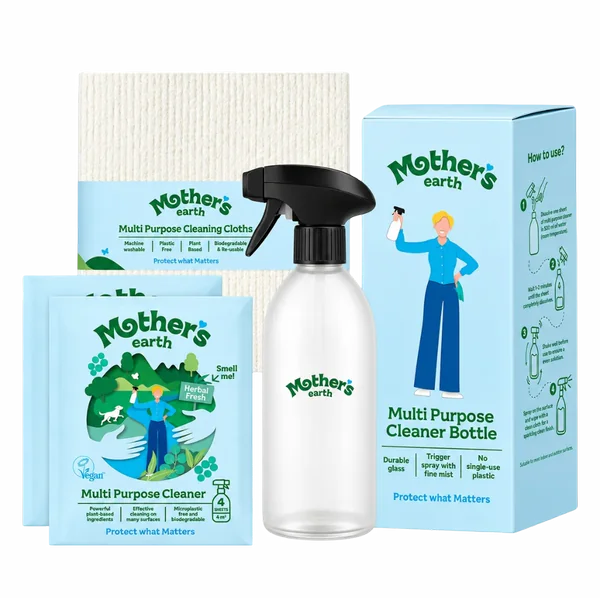
- In the kit: cleaning sheets and a glass spray bottle, with three plant-based cloths as a bonus
Mother's Earth is a Dutch family business started by a mother and her son, Lisette and Floris, who built one of the best-known names in laundry sheets, with more than 500,000 customers, by asking one question about every product: what actually needs to be in it, and what doesn't? Their Multi-Purpose Cleaner is that question applied to the spray you use around your baby, and it was the only one in my test that passed all five.
Why it came out on top
- No germ-killer, no bleach and no ammonia
- No MI, MCI or BIT
- No caustic soda, phosphates, EDTA or dyes
- A glass bottle you keep, with the sheets in a plastic-free box
- Every ingredient published, with what each one does
What does the cleaning instead
Take out the germ-killer, the bleach and the harsh helpers, and you're left with the part that actually cleans, which is exactly what Mother's Earth is made of: plant-derived cleaning agents and saponins, natural cleansers from plants that lift grease and grime the way soap does. A water softener made from a natural amino acid stops tap water leaving spots, so there's no need for EDTA either.
How it did in our kitchen
This was the part I was most sceptical about, because I half expected a gentle spray to mean more scrubbing. It didn't. One wipe took dried-on porridge off the high chair tray and the grease off the hob front, and the counter was left without a single streak.
Ten minutes later my daughter was back in her high chair with a piece of toast, and for the first time I didn't think twice about what was on that tray.
The Herbal Fresh version smells softly of herbs, a lot less chemical than a typical supermarket spray, and the fresh smell lasts longer than you'd expect.
How it works
- Roll one sheet and drop it into the glass bottle.
- Add 300 ml of tap water and shake until the sheet has dissolved.
- Spray onto the cloth or the surface, and wipe.
A bonus in the box: three cloths made from cellulose and cotton, instead of the usual plastic microfibre.
What parents say
"I love the smell and particularly the idea that the product is natural and thus, will not leave toxic chemicals behind."
Verified buyer
"Cleaned the kitchen, the doors and so on. Just spray and wipe. No streaks, great."
Customer comment
My verdict
It's the only spray in my test I'd happily use on a high chair every single day, because it cleans with what's needed and nothing more.
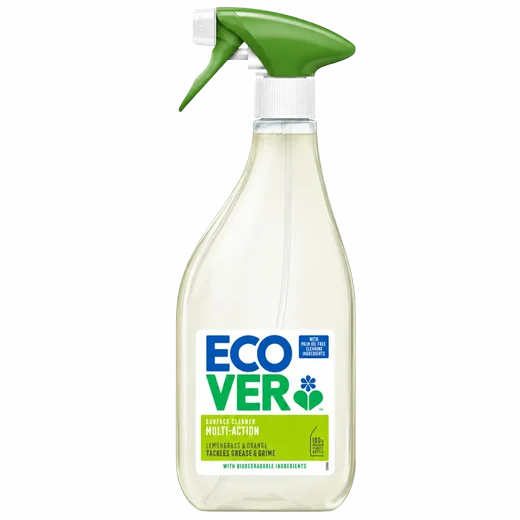
2Ecover Zero Multi-Action Spray: 4/5
A clean formula, but another plastic bottle every time
Ecover's Zero range is made for sensitive skin, and of all the supermarket sprays I tested, this was the closest to my winner on what's inside: no germ-killer, no bleach, no allergy-causing preservative and no harsh helpers.
Where it falls short of #1: every time you finish a bottle you buy a new one, so there's a plastic bottle and trigger in the bin every few weeks, and you're paying to carry 500 ml of mostly water home. The label also only says "less than 5% non-ionic surfactants", so you can't see what actually does the cleaning.
My advice: a good pick if you're already in the supermarket. If you want the same peace of mind without the plastic, choose #1.
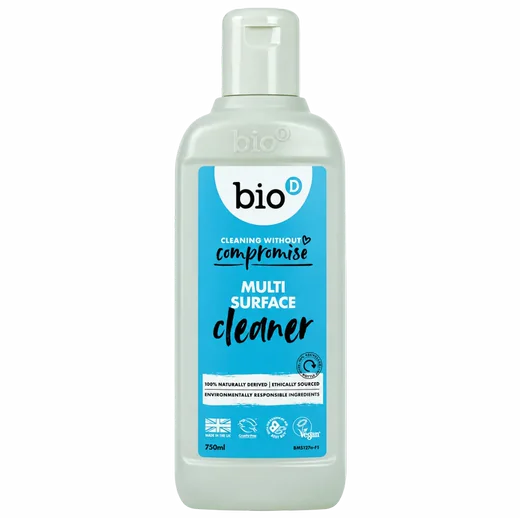
3Bio-D Multi Surface Cleaner: 4/5
A short, honest label in a plastic bottle
Bio-D has been making eco cleaning products since 1989, and its multi-surface cleaner has one of the shortest labels in my test: cleaning agents, salt, citric and lactic acid, and orange oil. There's no germ-killer, no allergy-causing preservative and no dye.
Where it falls short of #1: it comes in a plastic bottle (about £3.40 for 750 ml), and the refills come in large plastic containers, so the plastic never really leaves your home.
My advice: a solid choice from a health food shop. #1 gives you the same peace of mind in glass.
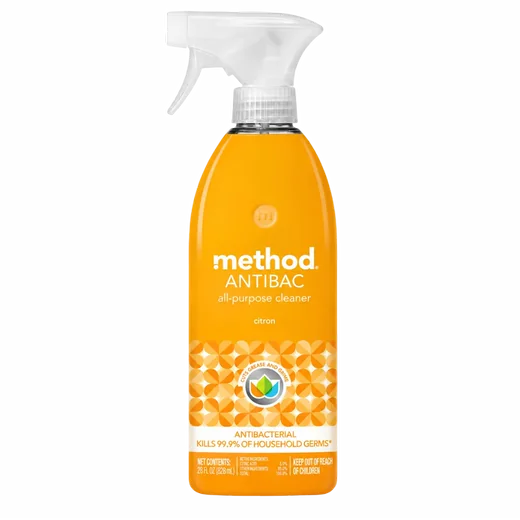
4Method Antibacterial All Purpose Cleaner: 4/5
No quats, but still a plastic habit
Method deserves credit for how its antibacterial spray works, because instead of a quat it uses lactic acid, which is naturally derived. There's no bleach, no allergy-causing preservative and none of the harsh helpers.
Where it falls short of #1: the bottles are plastic and so are the large refill packs, so there's plastic to throw away every time you run out.
My advice: a much better choice than the antibacterial classics, but #1 does the same job without the plastic.
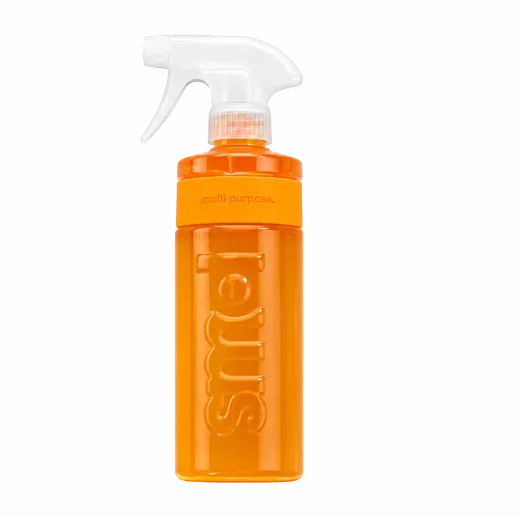
5Smol Multi Purpose Spray: 4/5
Refill tablets through the letterbox, with a dye you don't need
Smol posts small refill tablets through your letterbox, which you dissolve in water in a bottle you keep. The price per refill is low (£7 for 6 tablets), and the formula has no germ-killer, no chlorine bleach and no allergy-causing preservative.
Where it falls short of #1: the ingredient list contains a colourant, which does nothing for your surfaces and is only there to make the liquid look nicer in the bottle.
My advice: good value, but Mother's Earth leaves out the dye.
Why the big names didn't make the list
These are the bottles most of us have under the sink, and none of them scored more than three out of five.
Flash Spray Wipe Done (3/5). Flash leaves the germ-killer out of its everyday spray, which is to its credit, but it's preserved with benzisothiazolinone, one of the "epidemic" allergens from earlier, and it comes in a new plastic bottle every time.
Dettol Antibacterial (2/5). This was the one on my daughter's tray. It's the best-known antibacterial spray of all, and the clearest example of everything on my list: benzalkonium chloride (a quat), phenoxyisopropanol and monoethanolamine. Its refills are concentrates in small plastic bottles, so even refilling means more plastic.
Zoflora (2/5). Zoflora combines benzalkonium chloride with EDTA, and its own label tells you to keep pets off treated areas until they're completely dry. If that's the advice for your cat, think about your baby crawling across the same floor.
Cif Power & Shine Antibacterial (2/5). Cif's multi-purpose sprays had the highest dose of benzalkonium chloride in my test, and the Power & Shine Antibacterial adds caustic soda, sodium carbonate and a phosphate on top.
All results side by side
Only one product has a tick in every column.
So which spray should you use around your baby or toddler?
If you remember one thing from this test, make it this: the part of a spray that cleans is simple, and almost everything the big brands add on top of it is there to make a claim, not to make the high chair any cleaner. That means a germ-killer so the bottle can say "kills 99.9%", sometimes bleach, a preservative that dermatologists called an epidemic, and harsh helpers that end up on the tray your little one eats from.
Mother's Earth was the only spray in my test that left out all of it:
- No germ-killer, no bleach and no ammonia, because the surfaces your baby touches need cleaning, not sterilising
- No MI, MCI or BIT, the preservatives behind the skin-allergy epidemic
- No caustic soda, phosphates, EDTA or dyes
- A glass bottle you keep, so no plastic bottle in the bin
- Every ingredient published, with its name and what it does
If you'd like to see it for yourself, use it for a month on the high chair, the table and the floor your baby crawls on. If it doesn't clean the way you want it to, or you're simply not happy, Mother's Earth gives you your money back within 30 days, so the only thing you risk is finding out.
Frequently asked questions
Do I need to disinfect surfaces now that I have a baby?
For the surfaces your baby touches every day, no. Feeding bottles are something you sterilise, but a high chair, a table or a kitchen floor needs cleaning, which means wiping the dirt, the food and the germs sitting in them into a cloth. The germ-killer is what allows a bottle to claim "kills 99.9%", and it also happens to be the ingredient scientists are most worried about.
So Mother's Earth doesn't kill 99.9% of germs?
No, and that's the point. It cleans, so the dirt and the germs go into your cloth and then into the wash, instead of a germ-killer being left behind on the tray your baby eats from.
Can I use it on the high chair?
Yes, that's exactly what I use it for, every day. Spray it onto the cloth or the tray, wipe, and let the surface dry before the next meal.
Does it clean as well as a normal spray?
Yes. What lifts dirt and grease is the soap-like part, and that's exactly the part Mother's Earth keeps, because the germ-killer and the bleach were never what made your counter clean. In my test it took dried-on porridge off the high chair and grease off the hob in one wipe, without leaving streaks.
Aren't eco sprays all safe anyway?
The eco sprays in my test did a lot better than the big names, but none of them passed all five tests: three still came in a new plastic bottle every time, and one contained a dye that does nothing for your surfaces. A leaf on the front tells you very little, so turn the bottle around and read the ingredients instead.
What should I look out for on the label?
Benzalkonium chloride or anything ending in "ammonium chloride" (quats), sodium hypochlorite (bleach), ammonia, methylisothiazolinone, methylchloroisothiazolinone or benzisothiazolinone (preservatives), and caustic soda, phosphates, EDTA or colourants. Mother's Earth contains none of them.
Isn't it more expensive than a supermarket spray?
Per bottle it is, but the starter kit already includes the glass bottle and three cloths, and each sheet replaces a whole bottle of shipped water. Right now the starter kit is £17.99 on the flexible plan, or £24 as a one-off purchase, and you can pause or cancel the plan whenever you like.
Which surfaces can I use it on?
Kitchen counters, tables, high chairs, hobs, cupboard doors, tiles, ceramic, wood, stone and even marble. Just don't use it on screens or electronics.
How long does one bottle last?
One sheet makes a full 300 ml bottle. For the best result, use the mixed bottle within a month.
Where can I buy it?
Mother's Earth is only sold online, through its own shop, so you won't find it in the supermarket.
What if I don't like it?
Then you get your money back. Mother's Earth offers a 30-day money-back guarantee, so you can try it on your own high chair first.